
Accelerate Your Retention Performance
Get a personalized roadmap from Propel’s experts!

DTC supplement churn reduction is the practice of systematically decreasing the rate at which subscription supplement customers cancel, pause, or stop ordering — through retention marketing, product experience optimization, and lifecycle automation. With monthly subscription churn rates for DTC supplement brands averaging 7–10% for replenishment models and up to 15% for curation models, the difference between a 7% and a 12% churn rate compounds dramatically over 12 months. This guide covers the strategies, benchmarks, and real-world tactics that DTC supplement brands need to keep subscribers longer and grow lifetime value.
The DTC supplement industry is built on subscriptions — but subscriptions only work if customers stay. Here's the math that makes churn so dangerous:
A DTC supplement brand acquiring 1,000 subscribers per month at a $50 average order value and a 10% monthly churn rate will see its active subscriber base plateau at roughly 10,000 — no matter how much it spends on acquisition. Drop that churn rate to 5%, and the plateau jumps to 20,000 subscribers. Same acquisition spend, double the revenue.
The subscription ecommerce market continues to grow, but competition for supplement customers is intensifying. Brands that don't invest in retention will find their customer acquisition costs rising while their subscriber base stagnates.
Supplement brands face unique churn drivers that don't apply to other subscription categories. Customers often can't "feel" the product working (unlike skincare or food subscriptions), which creates perception problems. They forget to take the supplements, leading to oversupply and cancellations. They see competing products marketed with newer ingredients or better science. And they experience "subscription fatigue" from accumulating products they haven't finished.
Understanding these supplement-specific churn drivers is the first step to building a retention strategy that actually works.
Data sourced from Recharge's subscription metrics benchmarks and Smartrr's DTC churn analysis.
The key insight: access-based and membership models consistently outperform pure product subscriptions because they create value beyond the physical product. Brands that bundle community access, educational content, or health coaching with their supplements see 5–8% monthly churn — significantly better than product-only models.
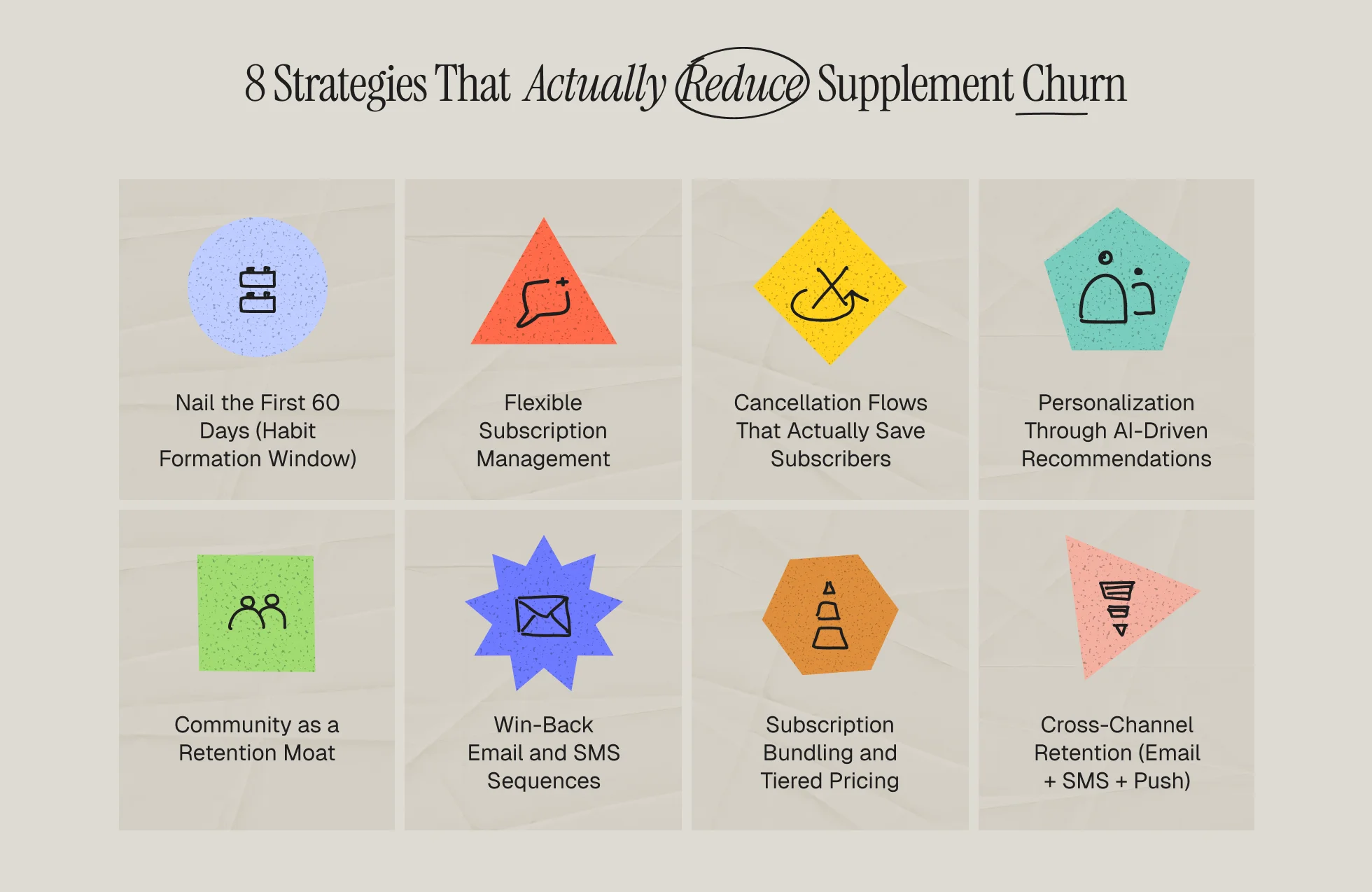
The most durable supplement subscription programs focus on creating genuine habit formation in the first 60–90 days of the customer relationship, rather than optimizing for initial subscription conversion. If a customer doesn't build a daily supplement habit in this window, they will churn.
How to implement:
Build a 60-day onboarding email sequence that includes a Day 1 welcome with clear usage instructions and habit tips, Day 3 reminder to set a daily alarm or pair the supplement with an existing habit, Day 7 check-in asking how they feel and reinforcing the science, Day 14 social proof (testimonials from customers who saw results), Day 30 milestone celebration with a "first month complete" email, and Day 45–60 education on expected timelines for results.
This onboarding approach aligns with Propel's methodology for reducing churn through better onboarding.
Rigid subscription models kill retention. Customers who can't pause, swap, or adjust their delivery will cancel instead. According to Recharge's data, flexible terms including the ability to easily swap products or pause deliveries without penalty reduce potential churn by 20–30%.
What flexibility looks like:
Pause subscription for 1–3 months (instead of canceling), swap products within the catalog, adjust delivery frequency (every 2, 4, 6, or 8 weeks), change quantity per delivery, and gift a shipment to someone else (keeps the subscription active). Every one of these options is a cancellation alternative that keeps the customer in your ecosystem.
Brands that implement thoughtful cancellation flows retain more than 40% of would-be churners. The key is understanding why someone is canceling and offering a targeted alternative.
Cancellation flow structure:
Step 1: Ask "why are you canceling?" with preset options (too expensive, too much product, didn't see results, switching to different brand, other). Step 2: Based on their answer, offer a specific save — "too expensive" gets a discount, "too much product" gets a frequency change, "didn't see results" gets an extended trial with educational content, "switching brands" gets a product comparison. Step 3: If they still cancel, ask for feedback and enter them into a win-back flow triggered 30, 60, and 90 days later.
By 2026, the integration of a Customer Data Platform (CDP) such as Segment or Bloomreach has become essential for brands aiming to deliver the personalization levels that modern consumers demand. For supplement brands, personalization means recommending the right products based on health goals, usage patterns, and purchase history.
Personalization in practice:
If a customer buys a protein powder, recommend complementary supplements (creatine, BCAAs) based on their fitness goals. If they've been subscribed for 6 months, suggest upgraded formulas or higher dosages. Use purchase velocity to predict when they're running low and trigger reorder reminders. Platforms like Klaviyo and Customer.io make this segmentation achievable — see our guide on behavioral segmentation strategies.
DTC supplement brands that excel at community building lower switching costs and increase emotional loyalty. A customer who's part of a brand community — interacting with other customers, sharing progress, getting advice — is far less likely to churn than one who's simply receiving a monthly shipment.
Community tactics that drive retention:
Private Facebook or Discord groups for subscribers, monthly live Q&As with nutritionists or brand founders, user-generated content campaigns (transformation stories, daily routines), loyalty programs that reward engagement (not just purchases), and ambassador programs that give top customers a stake in the brand.
Not every churned customer is lost forever. Well-designed win-back sequences can re-engage 10–15% of cancelled subscribers within 90 days.
Win-back flow structure:
Day 7 post-cancellation: "We miss you" email with a soft check-in (no offer). Day 14: Educational email about new research or product improvements. Day 30: Offer a "come back" discount (15–25% off first returning order). Day 60: SMS message with a personalized offer based on their purchase history. Day 90: Final outreach with the strongest offer or a "try something new" angle.
The key is not leading with discounts. Start with value (education, product news) and escalate offers over time.
Single-product subscriptions are the most vulnerable to churn. Brands that offer bundles or tiered membership models see significantly better retention because the perceived value increases with each additional product.
Bundling strategies:
Create "health stacks" — pre-built bundles for specific goals (energy, sleep, immunity, fitness). Offer tiered pricing: subscribing to 3+ products unlocks a premium discount tier. Include bonus items (samples, accessories) at higher commitment levels. Data from DTC subscription brands shows that customers subscribed to 2+ products churn at roughly half the rate of single-product subscribers.
Single-channel retention doesn't cut it for supplement brands. Customers need reminders across channels — email for education, SMS for urgent reminders, and push notifications for in-app engagement.
Channel strategy for supplements:
For a complete guide on building multi-channel campaigns, see our resources.
For a deeper look at platform options, see our guide to the best subscription retention tools.
Track these metrics monthly and use them to guide your retention marketing performance improvements.
Proven playbooks and strategies to turn retention into a growth driver!


.webp)