
.webp)
Summarize this documentation using AI
Key Takeaways
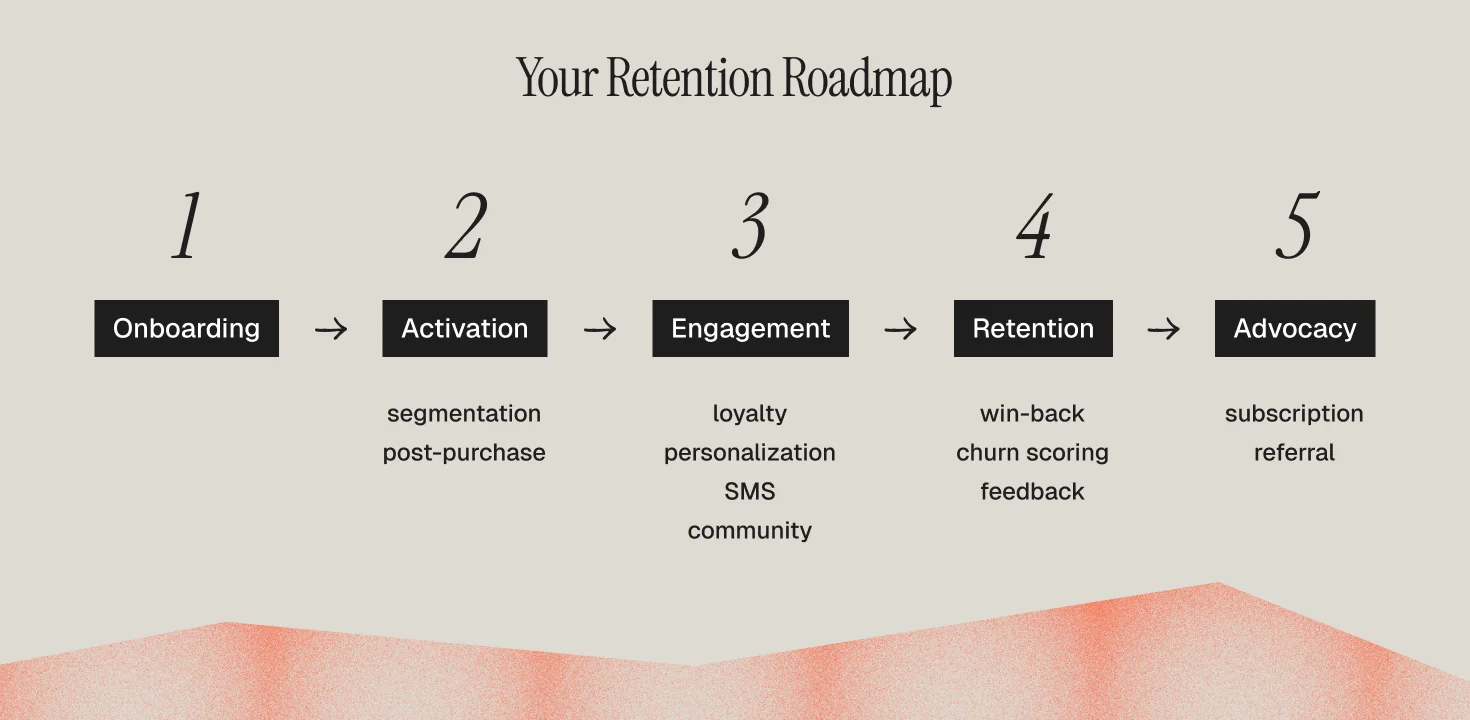
- Ranked list of 12 proven customer retention strategies for B2C and DTC brands in 2026.
- 1. Build a Proper Onboarding Email Sequence
- 2. Implement Behavior-Based Segmentation
The single most effective customer retention strategy in 2026 is building a proper onboarding email sequence — not just a welcome email, but a structured 5–7 touch flow that educates, activates, and creates habit. Brands that implement this one tactic see 15–20% lower first-month churn. Below, we rank all 12 of the most proven customer retention strategies by implementation difficulty, expected impact, and the brand types they work best for.
Key Takeaways
- Onboarding sequences are the #1 highest-leverage retention tactic — 15–20% reduction in early churn
- Behavior-based segmentation outperforms demographic segmentation by 2–3x on retention metrics
- Win-back flows recover 5–12% of churned customers — often the highest-ROI flow in your entire stack
- Predictive churn scoring is no longer enterprise-only — mid-market platforms now offer it natively
- The best retention strategies combine proactive engagement with reactive recovery
- SMS alongside email produces 28% higher retention than email alone
1. Build a Proper Onboarding Email Sequence
Why it works: 20% of customer churn happens in the first 30 days (Bain & Company). The onboarding window is the highest-leverage moment in the entire customer lifecycle — get it right and you build a habit; miss it and you lose the customer before they've experienced real value.
How to implement:
- Design a 5–7 email sequence triggered immediately after first purchase or sign-up
- Email 1 (Day 0): Welcome + clear next step (not just "thanks for joining")
- Emails 2–3 (Days 1–3): Product education — how to use it, when to expect results, tips for maximum value
- Email 4 (Day 5): Social proof — customer testimonials, user-generated content, community highlights
- Emails 5–6 (Days 7–10): Feature discovery or cross-sell introduction
- Email 7 (Day 14): Milestone check-in or feedback request
Example: A supplements brand Propel worked with added a 6-email onboarding sequence explaining when to expect results (Week 2), how to incorporate the supplement into daily routine, and sharing before/after testimonials. Result: first-refill rate increased 23% within 60 days.
Expected impact: 15–20% reduction in first-month churn. See our detailed guide on reducing churn with better onboarding and why retention strategies fail after onboarding.
2. Implement Behavior-Based Segmentation
Why it works: Batch-and-blast email is dead. Customers who receive messages tailored to their actual behavior — browsing patterns, purchase history, engagement level — retain at 2–3x the rate of those receiving generic communications.
How to implement:
- Segment by engagement level (active, at-risk, lapsed) and update segments dynamically
- Create behavior-triggered flows: browse abandonment, repeat purchase reminders, product usage milestones
- Use RFM analysis (Recency, Frequency, Monetary) to identify your highest-value and highest-risk segments
- Suppress unengaged contacts from promotional sends to protect deliverability
Example: A DTC skincare brand moved from 3 broad demographic segments to 12 behavior-based segments using Klaviyo. Open rates increased 38%, click rates doubled, and 90-day retention improved by 14%.
Expected impact: 2–3x higher retention metrics compared to demographic-only segmentation. For a deeper understanding, see our guide on behavioral triggers in retention marketing.
3. Launch a Win-Back Flow Before Customers Churn
Why it works: Most brands wait until a customer is completely gone before trying to win them back. The best retention programs identify at-risk behavior and intervene before the customer makes the cancellation decision.
How to implement:
- Define your "at-risk" trigger: 30 days without purchase (ecommerce), 14 days without login (app), declining email engagement
- Build a 3-stage win-back sequence with escalating urgency:
- Stage 1 (Day 30): "We miss you" + personalized content based on last activity
- Stage 2 (Day 45): Social proof + "here's what you're missing" with new products/features
- Stage 3 (Day 60): Incentive offer (discount, free shipping, bonus item)
- Track conversion by stage to optimize timing and offers
- Don't stop at email — add SMS and push for multi-channel win-back
Example: A subscription box brand implemented a 3-stage win-back flow on Customer.io that triggered at 21, 35, and 49 days of inactivity. Stage 1 recovered 4%, Stage 2 recovered 3%, and Stage 3 (with a 15% discount) recovered 5% — totaling 12% of at-risk customers saved.
Expected impact: 5–12% of churned or at-risk customers recovered. This is often the highest-ROI flow in your entire email stack. For templates, see our retention email templates guide.
4. Create a Loyalty or Rewards Program
Why it works: Loyalty programs create an accumulation incentive — points, tiers, or rewards that increase in value the longer a customer stays. This creates a tangible switching cost that pure subscription models lack.
How to implement:
- Choose a model: points-based (earn per dollar), tier-based (unlock benefits at thresholds), or hybrid
- Make earning visible and progress trackable
- Offer meaningful rewards — not just discounts, but exclusive access, early product launches, or free products
- Integrate with your email program: loyalty status updates, points balance reminders, tier advancement notifications
Example: Sephora's Beauty Insider program is the gold standard — three tiers (Insider, VIB, Rouge) with escalating perks. Members spend 15x more than non-members, and 80% of Sephora's revenue comes from Beauty Insider members.
Expected impact: 12–18% higher retention for loyalty program members vs. non-members (Smile.io).
5. Use Predictive Churn Scoring
Why it works: By the time a customer shows obvious signs of churning (stops opening emails, stops purchasing), it's often too late. Predictive churn models identify at-risk customers 15–30 days earlier, enabling proactive intervention.
How to implement:
- Use built-in predictive features in platforms like Klaviyo (predicted churn risk), Braze (predictive suite), or Customer.io (with integrated analytics)
- If your platform lacks native prediction, build a simple model using engagement decay: declining email opens, decreasing session frequency, increasing time between purchases
- Route high-risk customers into dedicated re-engagement flows with personalized content and offers
- Measure recovery rate by risk tier to optimize intervention timing
Expected impact: 15–20% churn reduction when combined with automated intervention flows.
6. Personalize Based on Purchase History and Browsing Data
Why it works: Generic emails get ignored. Personalized product recommendations based on what a customer has actually bought and browsed drive 26% higher revenue per email and significantly higher repeat purchase rates.
How to implement:
- Enable dynamic product recommendation blocks in your email templates
- Send "based on your last purchase" follow-up emails with complementary products
- Trigger browse abandonment emails featuring the specific products viewed
- Use purchase frequency data to time replenishment reminders (e.g., "Time to restock your protein powder?")
Expected impact: 26% higher revenue per email (Barilliance); 20–30% higher repeat purchase rate. For more tactics, see our retention email strategies guide.
7. Implement Post-Purchase Education Sequences
Why it works: The period between first purchase and second purchase is when most customers decide whether to come back. Education sequences that help customers get maximum value from their purchase dramatically increase the likelihood of repeat buying.
How to implement:
- Build a 3–5 email "value realization" sequence triggered after first delivery
- Content: how to use the product, tips for best results, common mistakes to avoid, expected timeline for results
- Include user-generated content and testimonials from similar customers
- End with a replenishment or cross-sell CTA timed to typical reorder window
Example: A DTC supplements brand sent a 5-email education sequence starting 3 days after delivery, explaining when to expect benefits (Week 2–3), how to maximize absorption, and sharing success stories. Second-order rate increased 28%.
Expected impact: 20–30% higher repeat purchase rate, particularly effective for supplements, skincare, and consumable DTC products.
8. Build a Subscription or Membership Model
Why it works: Subscription models convert one-time buyers into recurring customers by default. Customers who subscribe retain at 2.4x the rate of one-time purchasers (Recurly), because the payment is automatic and cancellation requires active effort.
How to implement:
- Offer a subscribe-and-save option with a meaningful discount (15–20% is the sweet spot)
- Make subscription management easy — let customers skip, pause, swap products, and change frequency without canceling
- Build subscription-specific email flows: upcoming order reminders, customization prompts, loyalty perks
- Address the "subscription fatigue" problem by providing value beyond just the product — exclusive content, community access, early launches
Expected impact: 2.4x higher retention vs. one-time purchase models.
9. Launch a Referral Program That Actually Rewards Advocates
Why it works: Referred customers have 16% higher CLV and 37% higher retention rates than customers acquired through other channels (Journal of Marketing). A referral program turns your best customers into your most effective — and cheapest — acquisition channel.
How to implement:
- Offer a two-sided incentive: reward both the referrer and the referred (e.g., "Give $20, Get $20")
- Make sharing effortless — one-click referral links in post-purchase emails and account dashboards
- Feature your referral program prominently in the customer journey — not buried in a footer
- Track referral quality (CLV of referred customers) not just referral volume
Expected impact: 16% higher CLV for referred customers; top referral programs generate 10–25% of new customer acquisition.
10. Use SMS Alongside Email (Not Instead Of)
Why it works: SMS + email combined produces 28% higher retention than email alone (Attentive). SMS excels for time-sensitive messages — flash sales, shipping updates, restock alerts — while email handles longer-form content and education.
How to implement:
- Use SMS for: shipping notifications, time-sensitive offers, restock alerts, appointment reminders
- Use email for: education, product recommendations, loyalty updates, content
- Don't duplicate — send different content on each channel
- Respect frequency: SMS is more intrusive than email, so limit to 4–6 texts per month
- Always get explicit SMS consent (legally required and good practice)
Expected impact: 28% higher retention vs. email alone. See our guide on how to do retention marketing right for channel strategy details.
11. Create Exclusive Content or Community Access
Why it works: When customers feel they belong to something — a community, an insider group, a members-only experience — cancellation means losing access to that identity. Community-driven retention is 25–40% more effective than discount-driven retention.
How to implement:
- Create a members-only community (Facebook Group, Discord, or branded forum)
- Offer exclusive content: early access to products, behind-the-scenes content, expert Q&As
- Feature community members in your marketing — UGC campaigns, customer spotlight emails
- Use community engagement data to identify brand advocates and at-risk customers
Expected impact: 25–40% lower churn for customers who engage with community features.
12. Regularly Survey Customers and Act on Feedback
Why it works: Customers who feel heard are customers who stay. Regular feedback collection — post-purchase surveys, NPS at key milestones, churn surveys — identifies friction before it causes churn and makes customers feel valued.
How to implement:
- Send a post-purchase survey at Day 7 (product experience) and Day 30 (ongoing satisfaction)
- Trigger an NPS survey at key milestones: 3rd purchase, 6 months active, subscription renewal
- For churned customers: send a brief exit survey to identify patterns
- Close the loop: actually use the feedback to improve, and tell customers what changed because of their input
Expected impact: 10–15% lower churn when feedback is systematically collected and acted upon.
Ready to implement these strategies for your brand? Propel designs and executes lifecycle marketing programs that combine multiple retention strategies into a cohesive system — not just one-off tactics. Book a strategy call →
For industry-specific context, check our customer retention statistics page (50+ data points) and retention rates by industry benchmarks.
Frequently Asked Questions
What is the best customer retention strategy?
Building a proper onboarding email sequence is the single highest-leverage retention strategy for most B2C brands. It addresses the highest-churn window (first 30 days), is relatively easy to implement, and consistently delivers 15–20% reduction in early churn. After onboarding, behavior-based segmentation and win-back flows are the next highest-impact tactics.
How do you improve customer retention rate?
Start with three foundational tactics: (1) audit your onboarding sequence — ensure it educates, activates, and builds habit within the first 14 days; (2) implement behavior-based segmentation so your messaging is relevant, not generic; (3) launch a win-back flow that triggers before customers fully churn. These three tactics alone typically improve retention by 15–25% within 90 days.
What are the most effective retention marketing tactics for ecommerce?
For ecommerce specifically, the five most effective tactics are: post-purchase education sequences (20–30% lift in repeat purchase), personalized product recommendations (26% more email revenue), loyalty programs (12–18% higher retention), subscribe-and-save options (2.4x retention vs. one-time), and cart + browse abandonment recovery flows (4.6% conversion rate). Combined, these tactics can double a brand's repeat purchase rate.
How much does a 5% increase in retention impact profits?
Bain & Company's research shows that a 5% increase in customer retention produces a 25–95% increase in profits, depending on the industry. The wide range reflects differences in customer lifetime value and margin structure. For DTC ecommerce brands with 50%+ gross margins, a 5% retention improvement typically translates to a 30–50% profit increase because repeat customers have zero acquisition cost and higher average order values.
What is the easiest retention strategy to implement first?
The easiest high-impact strategy to implement first is a win-back email flow. It requires only 3 emails (at 30, 45, and 60 days of inactivity), can be built in any email platform in under 2 hours, and immediately starts recovering lost revenue. After that, focus on improving your onboarding sequence and adding post-purchase education emails. These three flows form the foundation of any retention program.
