Summarize this documentation using AI
Key Takeaways
- Full teardown of Hinge's retention strategy — from onboarding and "Most Compatible" to HingeX monetization.
- Hinge's "Designed to Be Deleted" Positioning — And Why It's a Retention Strategy
- Onboarding and Activation Strategy
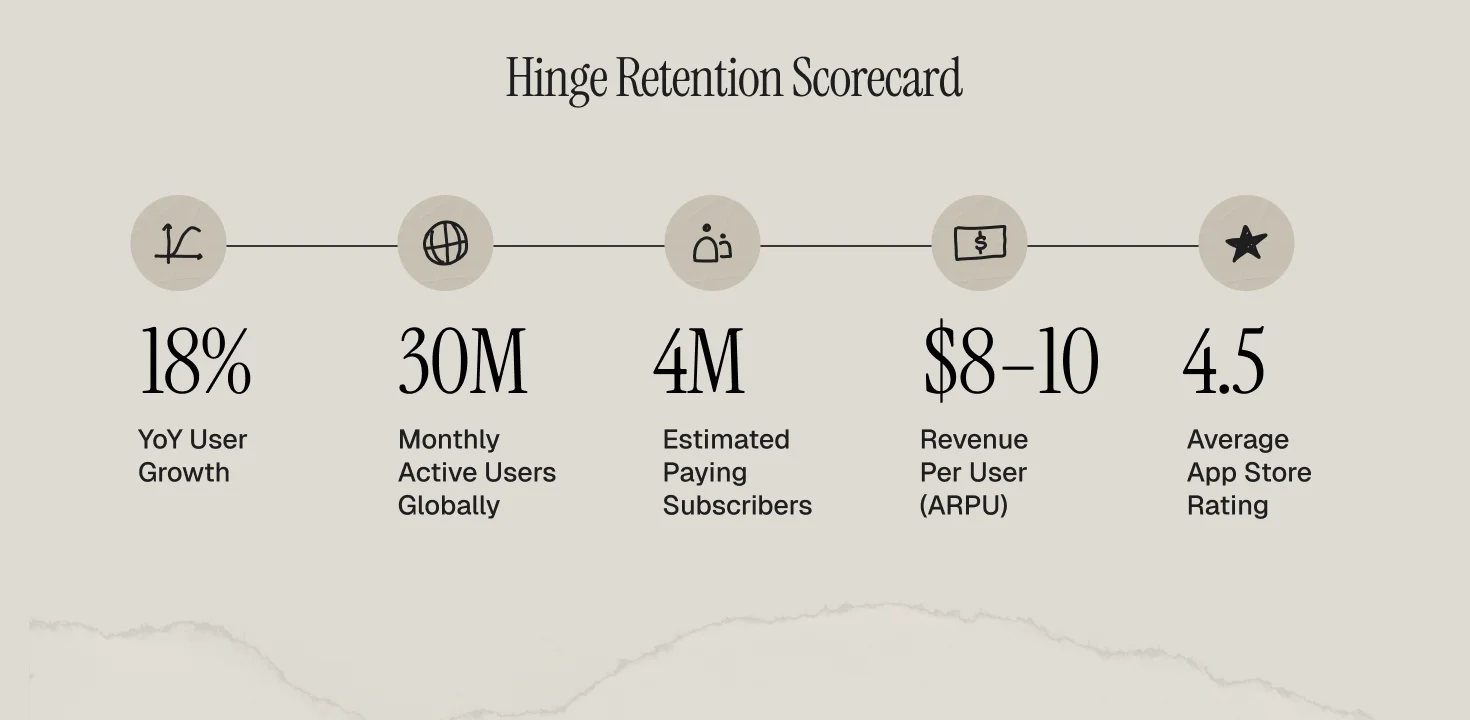
Hinge's "Designed to be deleted" tagline sounds like an anti-retention strategy — and that's precisely why it works. By positioning itself as the dating app focused on genuine relationships rather than infinite swiping, Hinge has built trust that translates directly into higher engagement, longer sessions, and premium conversion rates that outpace competitors. Hinge now reaches approximately 30 million monthly active users globally, with estimated ARPU of $8–10 across its user base and a premium conversion rate significantly above the dating app average.
Key Takeaways
- Hinge's "Designed to be deleted" positioning paradoxically drives higher engagement and trust than swipe-optimized competitors
- The "Most Compatible" daily match feature creates a daily habit loop — the single most powerful retention mechanic in the app
- Prompts-based profiles drive 2x deeper engagement per profile view compared to photo-only formats
- HingeX premium ($49.99/month) monetizes high-intent users before they delete — capturing LTV before churn
- Hinge's biggest retention gap: limited re-engagement for churned free-tier users
- Key lesson for B2C brands: positioning around customer success (not product stickiness) can be the most effective retention strategy of all
Hinge's "Designed to Be Deleted" Positioning — And Why It's a Retention Strategy
Most retention strategies try to make products stickier. Hinge does the opposite — it promises to help you leave. And this counterintuitive positioning is its greatest retention asset.
Here's the psychology: in a market flooded with dating apps optimized for endless swiping (Tinder) or superficial matching (Bumble), Hinge's promise of genuine connection resonated with users fatigued by the "dating app treadmill." When users believe an app is genuinely trying to help them succeed, three things happen:
1. Trust drives higher engagement. Users who trust Hinge's intent invest more effort into their profiles, write more thoughtful responses to prompts, and engage more deeply with each match. This deeper engagement per session means more data for Hinge's algorithm, which means better matches, which creates a virtuous cycle.
2. Quality perception extends tolerance. Users stay on Hinge longer without feeling "stuck" because the experience is framed as a journey toward an outcome, not a time-wasting habit. The same user who would angrily churn from Tinder after 3 months will stay on Hinge for 6+ months because the framing is different — they're "working toward finding someone," not "trapped in an addictive app."
3. Success stories become acquisition. When Hinge users find relationships, they become advocates — telling friends "I met my partner on Hinge." This word-of-mouth loop means Hinge's acquisition cost drops as its "churn" (successful deletions) increases. It's the rare business model where churn actually fuels growth.
For any B2C brand, this is a profound lesson: positioning around your customer's success — even if that means they eventually leave — can be a more powerful retention strategy than optimizing for lock-in. The trust dividend is real.
Onboarding and Activation Strategy
Hinge's onboarding is notably different from other dating apps, and every design choice serves retention.
Prompts-Based Profile Creation
While Tinder profiles are photo-driven, Hinge requires users to answer 3 "prompts" — open-ended questions like "I'm looking for someone who..." or "My simple pleasures are..." This does several things for retention:
- Higher investment = lower churn. Profiles that take 10–15 minutes to create are harder to abandon than profiles created in 30 seconds.
- Richer data for matching. Prompt responses give Hinge's algorithm text-based signals for compatibility matching, improving match quality — which is the #1 predictor of retention in dating apps.
- Deeper engagement per profile view. Users spend 2x longer viewing Hinge profiles compared to photo-only competitors, because there's more to read and react to. Each prompt can be "liked" individually, creating more specific conversation starters.
First Match Optimization
Hinge's algorithm heavily weights the first 48 hours. New users see a curated set of high-quality profiles (active, complete profiles with good engagement history) designed to maximize the probability of an early match. This "first match" moment is the activation event — Hinge's data suggests that users who get a match in their first 48 hours retain at 3x the rate of those who don't.
This mirrors a principle from Duolingo's retention strategy: the faster you can deliver the first "win," the higher the long-term retention rate.
The "Most Compatible" Daily Match
This is Hinge's most powerful retention mechanic. Every day, the algorithm identifies one profile it considers an ideal match for each user and presents it as "Most Compatible." This creates three retention effects:
- Daily habit loop. Users have a specific reason to open Hinge every single day — to see their "Most Compatible." This is functionally equivalent to Duolingo's daily streak, but without the guilt mechanics.
- Scarcity signal. One curated match feels more valuable than 50 random profiles. The exclusivity creates perceived quality.
- Algorithm training. User reactions to "Most Compatible" suggestions feed the algorithm, improving future suggestions in a data flywheel.
Notification and Re-Engagement Strategy
Hinge's push notification strategy is more restrained than competitors — and more effective because of it.
What Hinge sends:
- "Most Compatible" daily notification (the core habit trigger)
- New "Like" received alerts (immediate dopamine reward)
- Conversation reminders ("Don't keep [Name] waiting — reply to their message")
- Weekly activity summaries ("You had 5 conversations this week")
- Feature announcements (e.g., video prompts, voice notes)
What Hinge doesn't send:
- Mass promotional notifications
- "Someone is looking at your profile right now" engagement bait
- Aggressive "come back" messages at high frequency
This restraint matters. Dating app users are hypersensitive to notification quality — one irrelevant push can trigger an uninstall. Hinge's notifications feel helpful rather than desperate, which maintains the trust that their brand positioning promises. Brands in any B2C category can learn from this: notification restraint signals confidence and respect, both of which drive retention.
Monetization and Subscription Retention — HingeX
Hinge's free tier is deliberately generous enough to work (unlike some competitors that gate core functionality behind paywalls). The premium offerings — Hinge+ ($29.99/month) and HingeX ($49.99/month) — add power features rather than removing artificial limitations:
HingeX features: Enhanced profile visibility (2–3x more profile views), advanced preference filters, unlimited likes (free tier gets 8/day), "Priority Likes" that go to the top of someone's queue, and access to "who liked you" profiles.
Retention dynamics of the premium model:
- Free tier retains through quality. Because the free experience is genuinely functional, users develop engagement habits before encountering premium upsells. This is the "product-led" approach to monetization.
- Premium tiers capture high-intent users. Users willing to pay $50/month are the most motivated daters. HingeX captures their maximum LTV during the high-intent period, before they find a partner and delete the app.
- Scarcity mechanics drive conversion. The 8 likes/day limit on free tier creates scarcity that makes premium feel valuable rather than extractive. Users who've run through their daily likes and spot an ideal profile face a natural upgrade moment.
The key insight for B2C brands: Hinge monetizes urgency and intent, not frustration. Premium features make the experience better rather than removing artificial pain. This creates a sustainable premium retention model — users stay subscribed because they're getting value, not because they're trapped.
What Hinge Gets Right
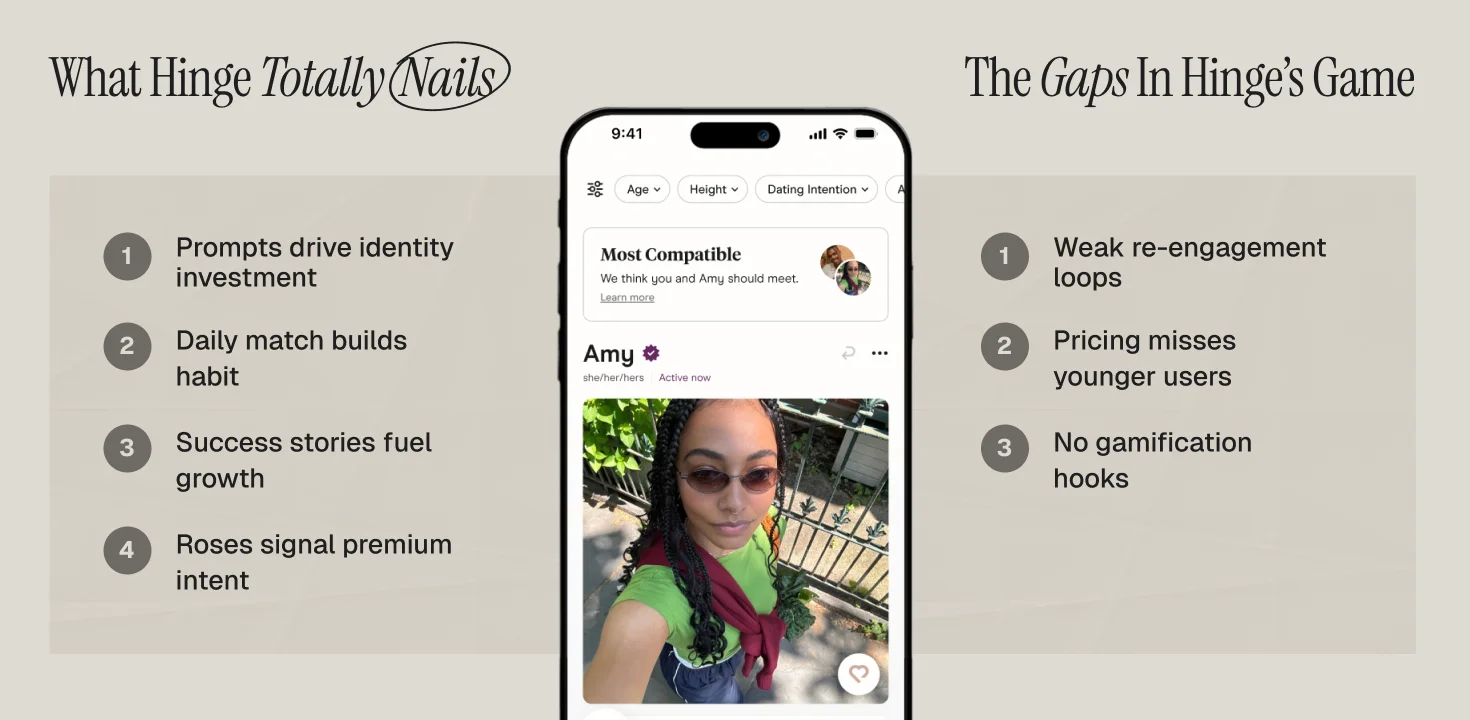
1. Prompts create identity investment. By the time a user has crafted 3 prompts, chosen 6 photos, and written a bio, they've invested genuine identity in their Hinge profile. This investment creates psychological switching costs that photo-only apps can't match. Any B2C brand can replicate this by creating onboarding experiences that involve personal investment — questionnaires, preference settings, customization.
2. Daily "Most Compatible" is a brilliant habit loop. One high-quality match per day is the perfect cadence: frequent enough to create a daily open habit, rare enough to feel special. For subscription brands, the equivalent is a daily personalized recommendation — one product suggestion, one content piece, one workout — that gives customers a reason to engage every day.
3. Success stories are marketing gold. Hinge actively collects and promotes "We Met on Hinge" stories across social media, their website, and even subway ads. Success stories serve double duty: they validate the brand promise (retention) and attract new users who want the same outcome (acquisition). Any B2C brand sitting on customer success stories is leaving retention and acquisition value on the table.
4. The Standout Rose mechanic creates premium engagement. Roses (limited, premium-only "super likes") create scarcity and signal genuine interest. When someone sends you a Rose, it feels meaningful — unlike a generic swipe. This translates to higher match acceptance rates and longer conversations. For B2C brands, the principle is: create mechanics that let customers signal elevated commitment or interest.
What Hinge Gets Wrong
1. Limited re-engagement for churned free-tier users. When a free-tier user deletes the app, Hinge's re-engagement is minimal — a generic "We miss you" email at best. Given that dating app usage is cyclical (people return to apps after breakups, moves, and life changes), Hinge is leaving recovery revenue on the table. A personalized re-engagement flow that referenced the user's previous matches, updated their "Most Compatible" algorithm, and offered a limited-time premium trial would significantly boost reactivation.
2. HingeX pricing alienates younger users. At $49.99/month, HingeX is priced for working professionals with disposable income. But Hinge's core demographic skews toward 25–35 year olds, many of whom find the price point unjustifiable. A mid-tier option between Hinge+ ($29.99) and HingeX — or student/age-based pricing — would capture revenue from high-intent users who currently stick with the free tier.
3. No gamification compared to competitors. While Hinge's restraint is generally a strength, the complete absence of any gamification mechanics (streaks, achievement badges, progress indicators) means there's no "investment loss" when a user takes a break. Compare this to Duolingo's retention strategy, where streaks create powerful daily engagement habits. A light-touch gamification layer — "You've been active for 14 days straight" or "You've sent 50 thoughtful comments on prompts" — could create healthy engagement reinforcement without undermining the brand's authenticity. Apps looking for strategies can check our guide on retention for early-stage mobile apps.
Lessons for Your Brand
Whether you're a consumer app, DTC brand, or subscription service, here are the transferable tactics from Hinge's playbook:
Position around customer success, not product stickiness. If your product genuinely delivers value, tell customers you want them to succeed — even if success means they eventually graduate from your product. This builds trust that converts into higher engagement, longer tenure, and powerful word-of-mouth. A supplements brand that says "We want to help you reach your health goals" retains better than one that says "Subscribe forever."
Create daily habit triggers that feel valuable. Hinge's "Most Compatible" works because it provides genuine value (a curated match), not because it manipulates (endless swiping). Find your "Most Compatible" — a daily personalized recommendation, a progress update, a curated selection — that gives customers a reason to engage without feeling manipulated.
Invest in onboarding depth, not just speed. Hinge's profile creation takes 10–15 minutes, and that investment drives retention. Don't rush customers through onboarding; guide them through meaningful personalization that makes the product better for them and harder to leave.
Monetize intent, not frustration. Premium features should enhance an already-good experience, not remove artificial gates from a degraded one. Customers who upgrade because they want more value stay longer than customers who upgrade because they're frustrated.
Build mechanisms to identify users about to churn early — declining app opens, fewer likes sent, shorter sessions — and intervene with personalized behavioral triggers before the deletion decision is made.
For more context on how dating app retention compares to other industries, see our retention rates by industry benchmarks, where dating apps average 35% annual retention with high variance between free and premium tiers.
Want Propel to analyze your app's retention strategy? We teardown lifecycle flows, identify retention gaps, and build implementation roadmaps for B2C brands and consumer apps. Talk to our team →
FAQs
What is Hinge's retention strategy?
Hinge's retention strategy combines counterintuitive brand positioning ("Designed to be deleted") with deliberate engagement mechanics. The core elements are: prompts-based profiles that create identity investment, the daily "Most Compatible" match that creates a habit loop, restrained but effective push notifications, and a premium tier (HingeX) that monetizes high-intent users before they find a relationship. The strategy prioritizes quality engagement over addictive usage patterns.
How does Hinge keep users engaged?
Hinge keeps users engaged primarily through its daily "Most Compatible" feature, which gives every user one algorithm-curated match per day — creating a reason to open the app daily. Beyond this, prompt-based profiles encourage deeper engagement per profile view, conversation starters reduce match-to-message drop-off, and weekly activity summaries maintain awareness. The 8 likes/day limit on free tier also creates a natural daily return pattern.
What does "designed to be deleted" mean for Hinge's business model?
"Designed to be deleted" means Hinge positions itself as a relationship-focused app rather than an engagement-maximizing one. For the business model, this works because: (1) trust drives higher engagement while on the platform, (2) premium conversion rates are higher because users with genuine intent are willing to pay, (3) success stories drive word-of-mouth acquisition that replaces churned users, and (4) dating is cyclical — many users return after relationships end, creating natural reactivation.
What is Hinge's churn rate compared to other dating apps?
Dating app annual retention averages approximately 35%, but there's significant variance. Hinge's retention is estimated to be above the category average due to its quality-focused approach and strong premium conversion. Tinder, which optimizes for casual engagement, likely retains a higher volume of users but with lower per-user monetization. Bumble falls between the two. The key metric for dating apps is revenue retention (ARPU × active user months), not just user retention, and Hinge excels here due to its $30–50/month premium tiers.
What can B2C apps learn from Hinge's retention approach?
Three transferable lessons: (1) Positioning around customer success builds trust that converts into engagement — tell customers you want them to achieve their goals, even if that means they eventually leave. (2) Create daily habit triggers that provide genuine value (like "Most Compatible"), not manipulative hooks. (3) Monetize through enhancement, not frustration — premium features should make an already-good experience better, not unlock artificially gated functionality. These principles apply to any consumer app, subscription service, or DTC brand.
Frequently Asked Questions
What Hinge Gets Right
Hinge Retention Strategy Teardown: How "Designed to Be Deleted" Actually Drives Retention is what this article covers in depth. The introduction and Key Takeaways section above outline the working definition Propel uses with our clients.
What Hinge Gets Wrong
Done well, it improves trial-to-paid conversion, repeat purchase rate, and 90-day retention — the three levers that compound into LTV. The article includes benchmarks from real B2C brands.
How do you implement hinge retention strategy teardown: how "designed to be deleted"?
Propel's process: (1) audit data layer & lifecycle, (2) define behavioral cohorts, (3) build flows in Customer.io, Braze, or Klaviyo, (4) launch with holdouts, (5) iterate weekly on KPIs.
What tools or platforms work best for hinge retention strategy teardown: how "designed to be deleted"?
Propel is platform-agnostic but holds Platinum/Certified partnerships with Customer.io, Braze, and Klaviyo. Tool choice depends on data layer maturity, channels (email, SMS, push, in-app), and team.
How quickly can a brand see results from hinge retention strategy teardown: how "designed to be deleted"?
Propel's 30-day money-back guarantee is built around early wins. Most brands see deliverability and segmentation lifts in week 2-3 and revenue or retention impact within 60-90 days.
