Pressure-test your BFCM plan before November does.
A few BFCM decisions are far easier to make now than to discover during the biggest sending weeks of the year. Start with the ramp math, then work through the six checks.
Free to run. The planner needs no sign-up.

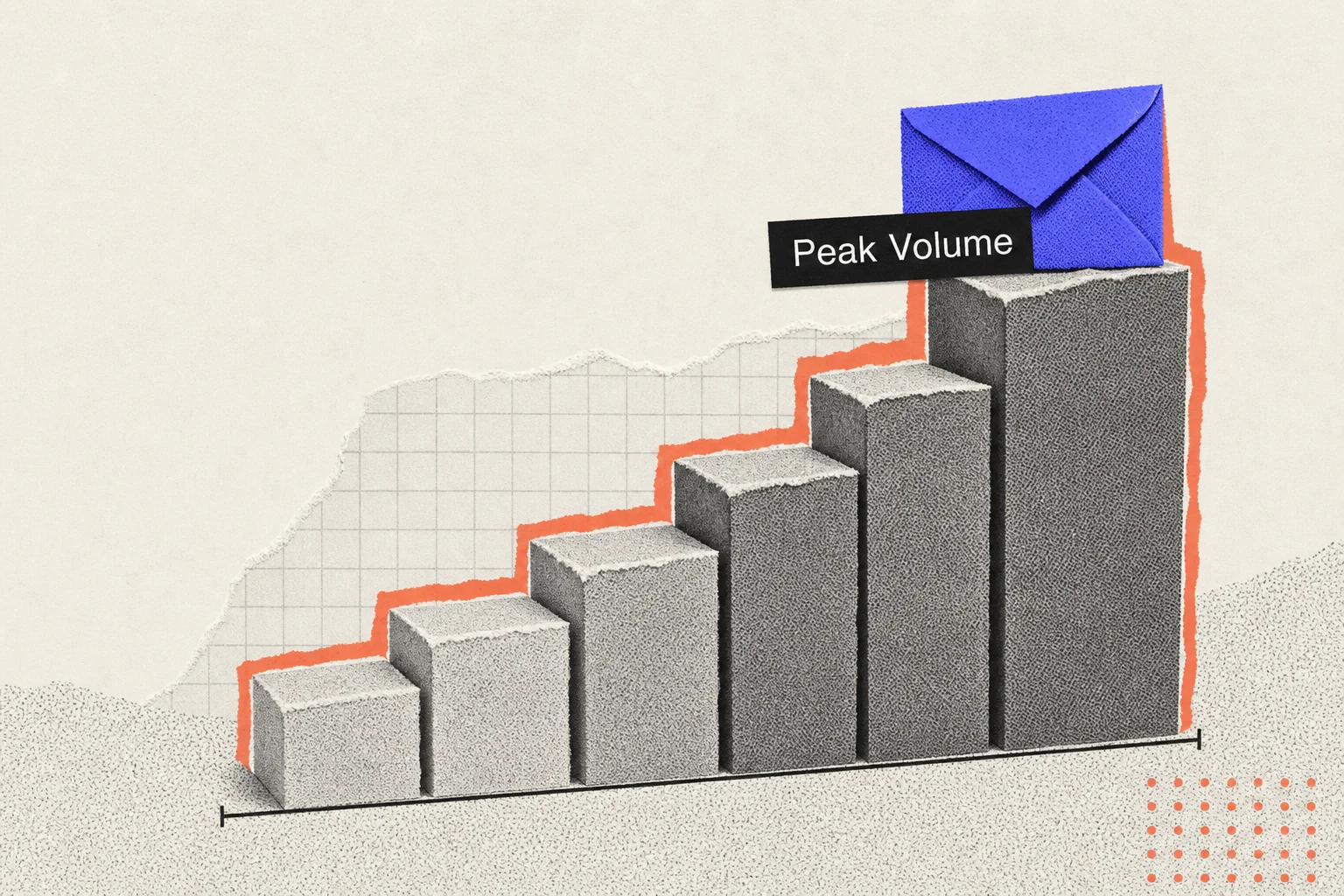
Can your sending reach peak volume without wrecking your domain?
You cannot jump from today's volume to your November peak overnight. Mailbox providers read a sudden spike as suspicious and quietly start filtering. Enter four numbers and see the day-by-day ramp, and whether your calendar has room for it.
This is an illustration of the ramp, not a guarantee of inbox placement. It assumes a gradual step of about 1.5x held for three days at a time. Your real ramp depends on sender reputation, engagement, list composition and other deliverability signals.
About the calculator
What the ramp planner is actually doing
The ramp planner is the calculator above. You enter four numbers, current daily sends, your BFCM peak target, today's date and the sale date, and it returns a day-by-day schedule for safely growing your email volume up to peak.
The problem it solves
You cannot jump from 40,000 sends a day to 200,000 overnight, which is what most brands do, and then they end up in spam in the middle of the sale. Mailbox providers like Gmail read a sudden spike as suspicious and start sending your mail to spam, right when it matters most. Volume has to be increased gradually, and the planner works out that schedule for you.
How it calculates
It uses a standard warm-up rule: increase volume about 1.5x, hold for about three days so it settles, then step up again, repeating until peak. From that it shows how many days a safe ramp needs against how many days you actually have.
Days needed is the number of 1.5x steps between where you are and your peak, times three. Days available is the gap to your sale date, minus a short buffer so peak lands before the sale rather than on the morning of it.
What it does not claim
It is framed as an illustration, not a guarantee. Real deliverability also depends on sender reputation and list quality, which a calculator cannot see. That is what a BFCM audit looks at.
Channel recovery
Is email doing all the recovery work?
It is the question worth asking before the plan is locked. Email carries the sale, but it is also the channel most exposed during peak week, and the one competing hardest for attention. The brands that recover revenue during BFCM rarely do it in one channel.
The spine of the sale, and the thing most at risk.
Ramp, placement and offer progression all live here, which is why most of this page is about protecting it. When email degrades mid-sale, everything downstream of it degrades too.
SMS
Where recovery actually happens fast.
Cart and checkout abandons during peak week resolve in minutes on SMS, not hours in an inbox that is already full. It is also the channel that keeps working when email placement wobbles.
Voice
The channel that answers a medical question.
A discount cannot tell someone whether treatment is right for them or safe. For a considered medical decision, a call or voice follow-up resolves the hesitation that no amount of copy will.
If email is the only channel in your BFCM plan, then every deliverability problem in the six checks below is also a revenue problem with no fallback. SMS and voice are what turn a placement dip into a delay rather than a loss.
The pressure test
Six questions worth answering honestly before the plan is locked.
These are the decisions that quietly leak revenue during peak week and rarely show up as a line item. Each one includes what a stronger plan tends to do instead.
Most telehealth brands do hit their volume peak during BFCM. The problem is how they get there. They push from 30k to 40k a day up to 150k or 200k in a matter of days, and mailbox providers read that spike as a change in behavior. Filtering kicks in, complaint rates climb, and a slice of the best sale of the year lands in spam.
The damage does not end when the sale does. A domain that gets burned during peak week carries a weaker reputation into December and beyond, so the refill, renewal and win-back emails you send after BFCM open at a lower rate too. You spend the rest of the quarter paying for one week of over-sending.
BFCM does not begin the day the offer goes live. If the first message about the sale is the sale itself, launch day has to create demand and capture it at the same time, on the noisiest inbox day of the year. You are launching to a cold list on your most important morning.
Demand-building should start roughly three weeks out. A workable shape: teasers and "something is coming" from about the second week of November, a named early-access or waitlist push in the week before, then launch to a list that is already leaning in.
A test started inside the sale never reaches significance before the sale is over, so you spend your biggest budget guessing. Peak week is the worst possible time to be discovering what resonates.
Decide the winners in October, on lower-stakes sends: subject-line angles, the hero message, discount framing, and which segments respond to what. By the time peak week ships, it should carry only proven creative and offers.
A GLP-1 or HRT decision is a considered medical purchase, not an impulse buy. A discount can get attention, but it does not answer whether treatment is right for someone, whether it is safe, or whether it is worth acting on now. Lead on price alone and you attract discount-hunters who churn in January while your serious patients feel sold to.
A flat discount running the full window trains your best buyers to wait, because nothing improves by acting now. Opens and clicks fade after the first couple of days, and the people who did not act on day one are given no new reason to act on day six.
The offer itself should move. For example, hold 30% off through the main window, then push to 40% off in the final 48 hours with a clear "last chance" message. That gives the high-intent people who were on the fence a fresh, concrete reason to convert today, and it reliably lifts the back half of the sale, which is usually where the best buyers sit.
During peak week, send volume and complaint rates both spike. Even a well-run sale sees more people mark messages as spam simply because everyone is sending more, and that pushes your primary sending domain's reputation down at the worst possible moment. Once it starts landing in spam mid-sale, you are stuck: you cannot warm a fresh domain in the middle of BFCM, because warming takes weeks you no longer have.
That is why the time to prepare is now. Brands that protect the sale keep two or more backup domains already warmed before BFCM begins, dedicated to the sale, so if the primary degrades you can shift volume to a domain that is ready rather than watch the revenue leak.
Every one of these is easier to fix in October than to discover in December. We put all six, with the plays, in one checklist.
Work with Propel
Get my detailed BFCM audit.
We will run the same six areas against your actual program and calendar, and show you exactly what we would pressure-test before the biggest sends go out.
- ✓Your real send-ramp math against your BFCM dates and sender reputation.
- ✓Whether your backup domains are warmed and ready to protect the sale.
- ✓Where pre-sale demand, testing and offer progression have gaps.
- ✓How patient value is carrying through the discount, or getting lost behind it.
A working session, not a pitch. You leave with the areas worth fixing either way.
The Telehealth BFCM Pre-Flight Checklist
Eighteen pages on the six decisions that are easier to make in October than to discover in December, including the full send-ramp math behind the planner above.
- The worked ramp, 20,000 to 200,000, step by step
- A ten-week countdown you can hold your calendar against
- The twelve-point checklist, built to print
We use your email to send the checklist and, if you tick the box, occasional lifecycle notes. Unsubscribe any time.
It is on the way.
A copy is heading to your inbox. You can also grab it right now, and the rest of the page is open.
Download the checklistNothing else to do. Close this and keep reading.